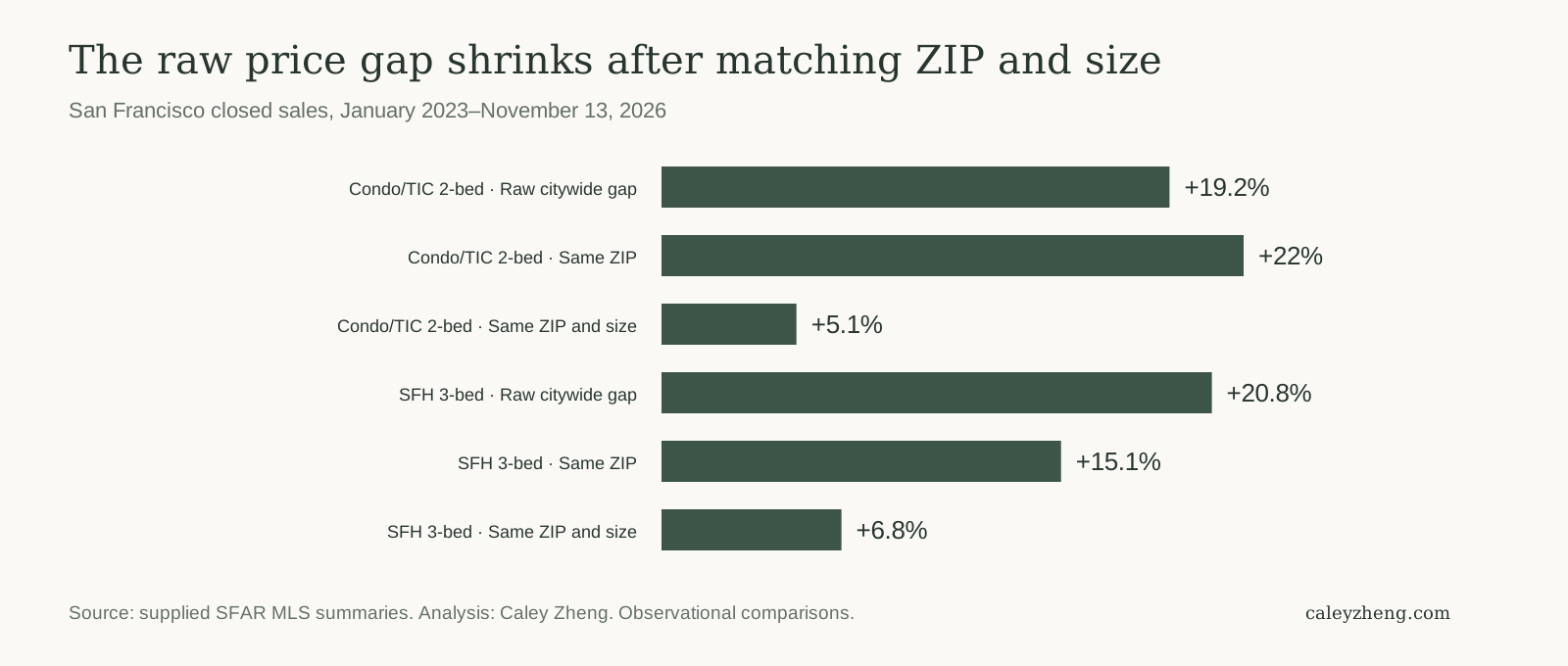
A second bathroom is associated with a much smaller sale-price premium than raw citywide comparisons suggest. Across the supplied San Francisco sales summaries, two-bedroom condos and TICs with two bathrooms sold for 5.1% more within the same ZIP code and size band. For three-bedroom houses, the corresponding gap was 6.8%.
The weighted dollar differences were approximately $49,000 and $90,000. These are historical comparisons across 2023–26 sales, not current appraisals or guaranteed renovation returns.
View source data
| group | comparison | n 1 bath | n 2 bath | premium pct | median dollar gap | size difference pct |
|---|---|---|---|---|---|---|
| Condo/TIC 2-bed | Raw citywide gap | 749 | 2287 | 19.2 | 205000 | 16.4 |
| Condo/TIC 2-bed | Same ZIP | 745 | 2194 | 22.0 | 222120 | 18.0 |
| Condo/TIC 2-bed | Same ZIP and size | 618 | 1234 | 5.1 | 49342 | 1.2 |
| SFH 3-bed | Raw citywide gap | 341 | 1475 | 20.8 | 275000 | 22.7 |
| SFH 3-bed | Same ZIP | 334 | 1434 | 15.1 | 198090 | 18.3 |
| SFH 3-bed | Same ZIP and size | 292 | 1026 | 6.8 | 89947 | 2.0 |
Why the raw gap looks so large
In the full sample, two-bathroom condos and TICs had a 19.2% price gap over one-bathroom units. They were also 16.4% larger by median living area. For houses, the price gap was 20.8% and the size difference 22.7%.
Comparing homes within the same ZIP code alone does not remove these differences. Grouping by both ZIP and narrower size bands brings the observed gap down considerably. That suggests size and location explain much of the raw difference, although this analysis does not isolate every factor that affects price.
How stable is the result?
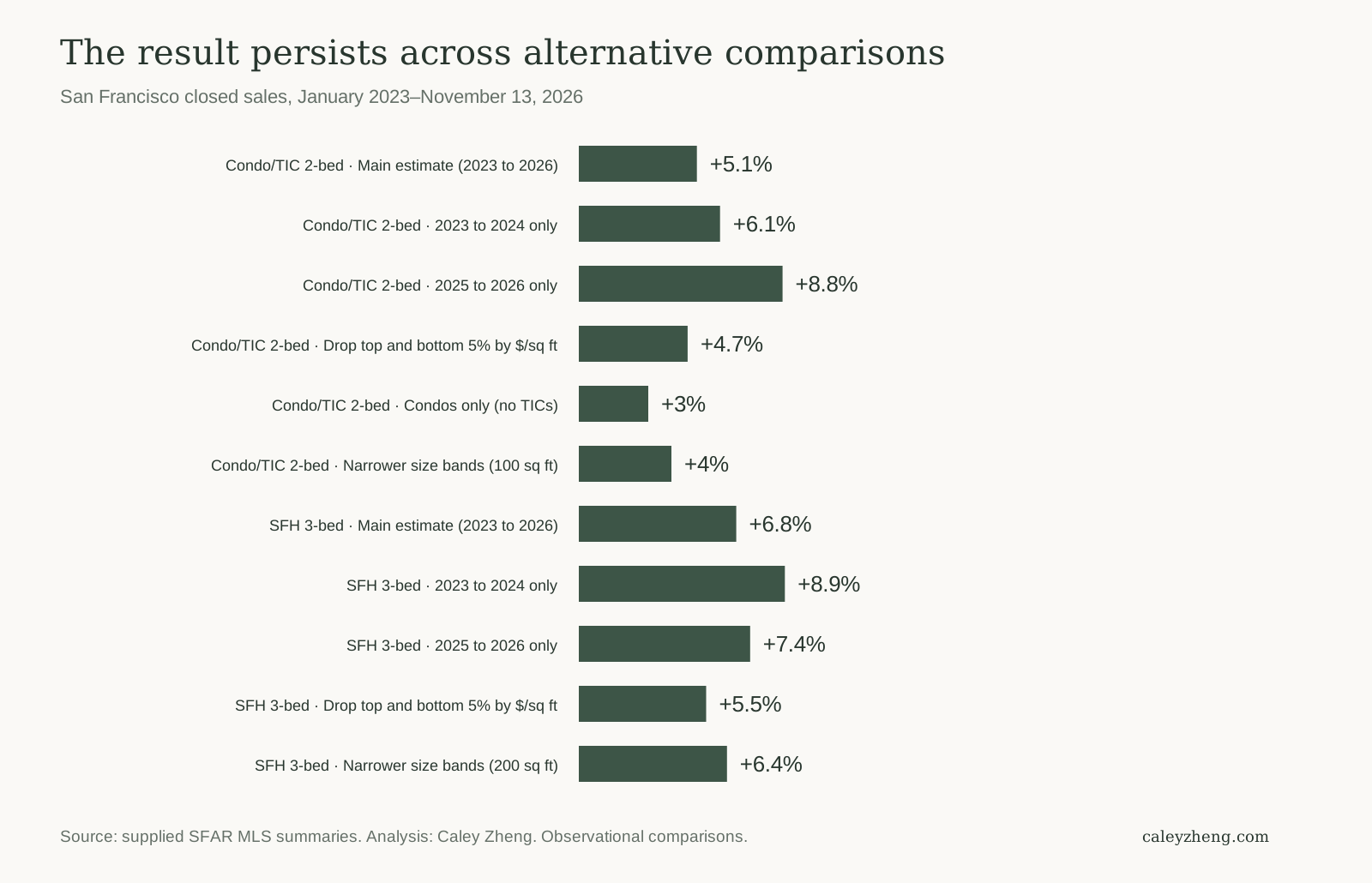
The condo/TIC estimate ranges from 3.0% to 8.8% across the supplied comparisons. The condo-only result is 3.0%, while the 2025–26 result is 8.8%. House estimates range from 5.5% to 8.9%. These are sensitivity checks using different samples and methods, not confidence intervals.
View source data
| group | test | n 1 bath | n 2 bath | zip size cells | premium pct | avg dollar gap |
|---|---|---|---|---|---|---|
| Condo/TIC 2-bed | Main estimate (2023 to 2026) | 618 | 1234 | 61 | 5.1 | 49342 |
| Condo/TIC 2-bed | 2023 to 2024 only | 241 | 477 | 36 | 6.1 | 61535 |
| Condo/TIC 2-bed | 2025 to 2026 only | 271 | 426 | 38 | 8.8 | 84030 |
| Condo/TIC 2-bed | Drop top and bottom 5% by $/sq ft | 572 | 1104 | 57 | 4.7 | 46604 |
| Condo/TIC 2-bed | Condos only (no TICs) | 467 | 1048 | 51 | 3.0 | 27798 |
| Condo/TIC 2-bed | Narrower size bands (100 sq ft) | 542 | 1073 | 67 | 4.0 | 38445 |
| SFH 3-bed | Main estimate (2023 to 2026) | 292 | 1026 | 34 | 6.8 | 89947 |
| SFH 3-bed | 2023 to 2024 only | 130 | 380 | 23 | 8.9 | 104171 |
| SFH 3-bed | 2025 to 2026 only | 121 | 333 | 21 | 7.4 | 95613 |
| SFH 3-bed | Drop top and bottom 5% by $/sq ft | 267 | 924 | 32 | 5.5 | 70804 |
| SFH 3-bed | Narrower size bands (200 sq ft) | 288 | 830 | 38 | 6.4 | 83700 |
Matching within a ZIP and size band is useful, but it is not a controlled experiment. Condition, light, layout, building age, parking and other features can still differ. The remaining bias could run in either direction. The figures should not be read as the causal value of constructing a bathroom.
Size changes the comparison
View source data
| group | size band | n 1 bath | n 2 bath | zip size cells | premium pct | avg dollar gap | median price 1 bath |
|---|---|---|---|---|---|---|---|
| Condo/TIC 2-bed | Under 900 sq ft | 139 | 122 | 14 | 8.0 | 41862 | 821500 |
| Condo/TIC 2-bed | 900 to 1,199 sq ft | 330 | 787 | 29 | 1.6 | 7923 | 1092500 |
| Condo/TIC 2-bed | 1,200+ sq ft | 149 | 325 | 18 | 10.0 | 131788 | 1350000 |
| SFH 3-bed | Under 1,500 sq ft | 217 | 548 | 21 | 6.0 | 76214 | 1312500 |
| SFH 3-bed | 1,500 to 1,999 sq ft | 75 | 478 | 13 | 9.1 | 129133 | 1600000 |
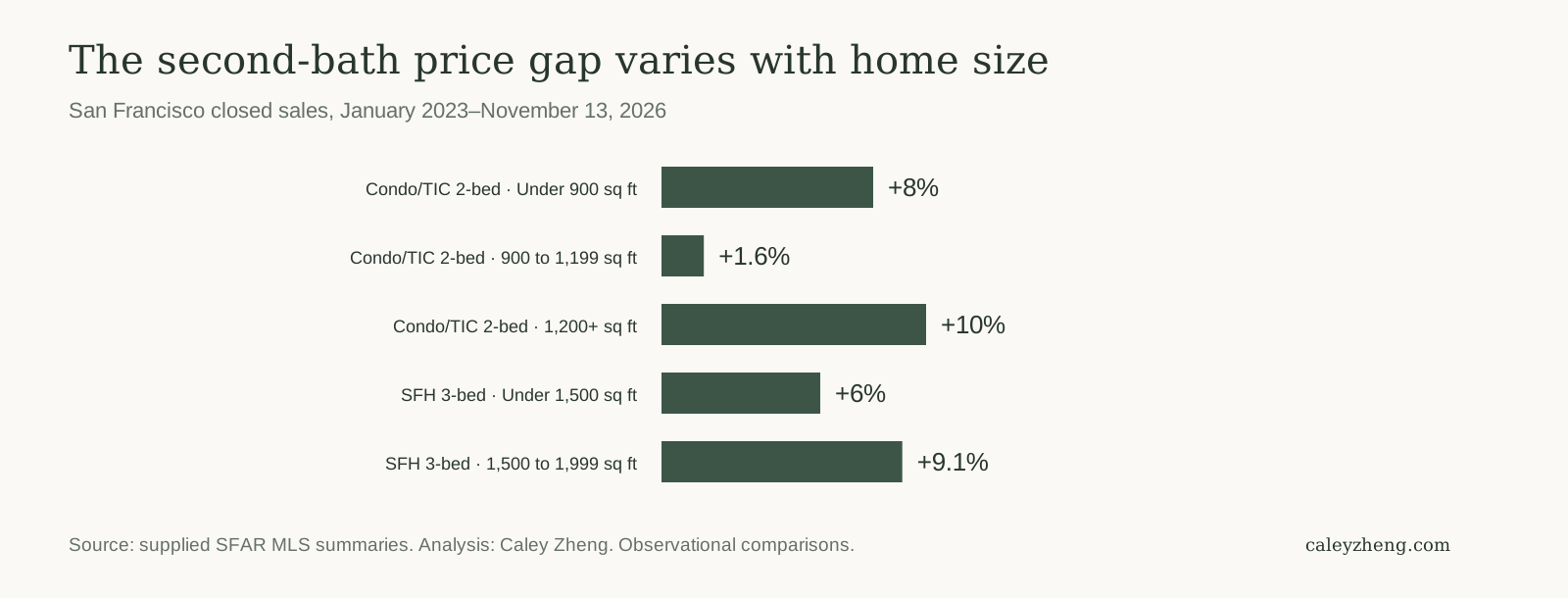
For two-bedroom condos and TICs between 900 and 1,199 square feet, the observed gap was only 1.6%, with a weighted dollar difference of $7,923. Units of 1,200 square feet or more showed a 10.0% gap and a weighted dollar difference of $131,788.
These subgroup estimates have smaller samples. The under-900-square-foot condo group contains 14 qualifying ZIP-size cells. The 1,500–1,999-square-foot house group contains 13 cells and only 75 one-bathroom sales. Houses of 2,000 square feet or more are omitted because too few one-bathroom sales qualified.
Does adding a bathroom pay for itself?
I would not underwrite a bathroom addition using the raw 19% citywide gap. Start with recent comparable sales, a workable floor plan and an all-in project estimate. Consider design, permits, construction, building approvals, contingency and carrying costs.
For illustration, a $74,000 project compared with the sample’s $49,342 condo/TIC dollar gap leaves a difference of approximately negative $24,658. That is scenario arithmetic, not a forecast. An existing two-bathroom home can differ from the home you would create, especially if construction reduces living space or changes the layout.
Larger units and houses may justify closer investigation, but their stronger observed price gaps do not guarantee that an addition will pay. The value of using a second bathroom over several years is also separate from its eventual resale value.
Explore a bathroom-addition scenario
Select a sample segment, enter the estimated value of your one-bathroom home, and enter your all-in project cost. This applies the segment’s observed percentage gap to your value. It does not estimate a permitted project’s actual return.
What buyers and owners can do
Buyers should compare location, living area, condition, layout and monthly costs together. A one-bathroom home can be competitive with a similarly sized two-bathroom home. Think about how your household would use the space before paying a large premium or assuming you can add a bathroom later.
Owners considering a sale should get a contractor’s scope and a comparable-sales review before committing. A renovation that improves daily life may be worthwhile even when resale recovery is uncertain. If the goal is a near-term sale, compare the addition with smaller improvements and the option of selling as-is.
Continue with Caley’s renovation guides, TIC versus condo pricing, and condo HOA costs.
Common questions
Does a second bathroom add value?
Two-bathroom homes sold for more in these matched groups, with a 5.1% gap for two-bedroom condos/TICs and 6.8% for three-bedroom houses. The comparison does not establish what a particular addition would add.
Is a two-bedroom, one-bathroom condo a bad buy?
Not necessarily. In the 900–1,199-square-foot group, the observed price difference was small. The right purchase depends on layout, price, building finances and your needs.
How much should I budget for an addition?
Use a written, property-specific estimate rather than a citywide sale-price gap. Scope, plumbing access, design and building requirements can change the project substantially.
Methodology and limits
Source: user-supplied SFAR MLS summary CSVs and SQL, received November 16, 2026. The supplied draft describes closed sales from January 1, 2023 through November 13, 2026: 3,036 two-bedroom condos/TICs and 1,816 three-bedroom houses, totaling 4,852 sales. The SQL uses a rolling CURRENT_DATE upper bound, so rerunning it later will not reproduce the same cutoff without fixing that date. Underlying transaction records were not provided for independent replication.
Filters exclude future-dated closes, prices of $100,000 or less, living areas outside 400–6,000 square feet and prices per square foot outside $300–$4,000. Bathroom counts of 1, 1.5, 2 and 2.5 are grouped by their full-bath count. The supplied files do not include the strict 1.0-versus-2.0 check output.
The main comparison uses ZIP code and 150-square-foot bands for condos/TICs or 250-square-foot bands for houses. Each cell requires at least three sales in each bathroom group. Cell median-price ratios are weighted by the smaller group count. The qualifying samples contain 1,852 condo/TIC sales across 61 cells and 1,318 house sales across 34 cells.
Percentage and dollar gaps are separately weighted statistics; multiplying a pooled median by a reported percentage need not reproduce the reported dollar gap. Results pool different years and properties. They are descriptive, do not control for every feature and are not a renovation appraisal.
Thinking about adding a bath or buying a home with one? Talk with Caley about the numbers.
Working through a TIC decision? The TIC learning center connects the ownership, financing, costs, and buyer-diligence guides.