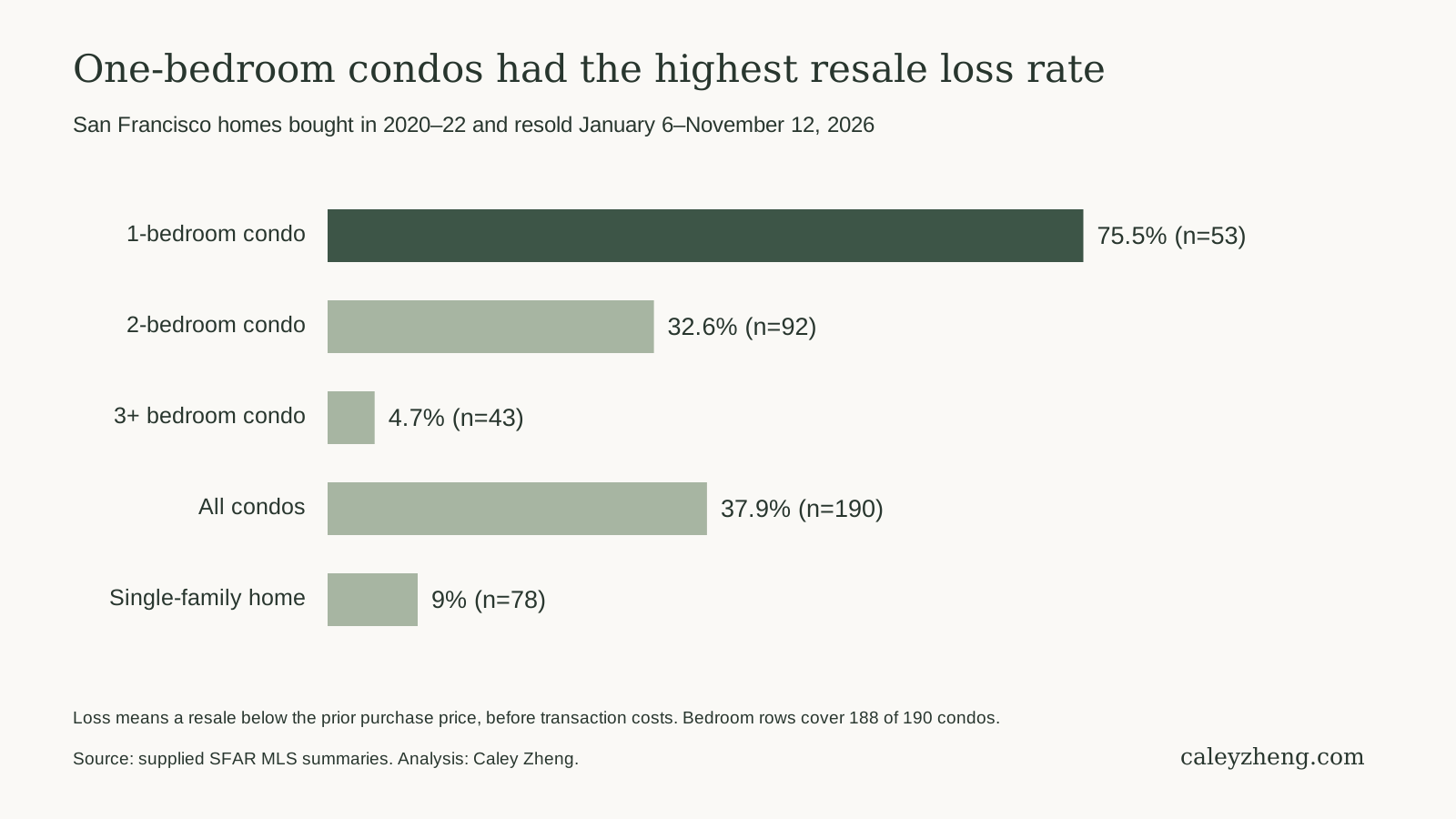
Among San Francisco condos bought in 2020–22 and resold in 2026, 38% closed below their prior purchase price, compared with 9% of single-family homes. One-bedroom condos had the highest loss rate: about 76%.
What does “selling at a loss” mean?
Here, a loss means the recorded resale price was lower than the recorded prior purchase price. It does not measure an owner’s full investment return, mortgage payoff or cash received at closing.
The median condo in the sample gained 6.1% between purchase and resale, compared with 21.8% for houses. Among condos that sold below their purchase price, the median decline was $96,750, or 9.8%.
Transaction costs change the calculation. The supplied analysis estimates that 49% of the condo sample would fall below purchase price after an assumed selling cost of 5% of the resale price. Actual costs vary. This estimate excludes purchase costs, improvements, carrying costs, rental income and inflation.
With that assumption, a $1 million purchase needs a resale price of about $1,052,632 to recover the purchase price after selling costs: $1 million divided by 0.95. Recovering the owner’s complete investment may require more.
The loss rate improved, but the recovery remains uneven
A separate comparison follows homes bought in 2020–21, grouped by the year they resold. Condo loss rates hovered near 60% in 2023, 2024 and 2025, then fell to 38.5% in 2026 through November 12. The house loss rate fell from 29% in 2025 to 12% in 2026.
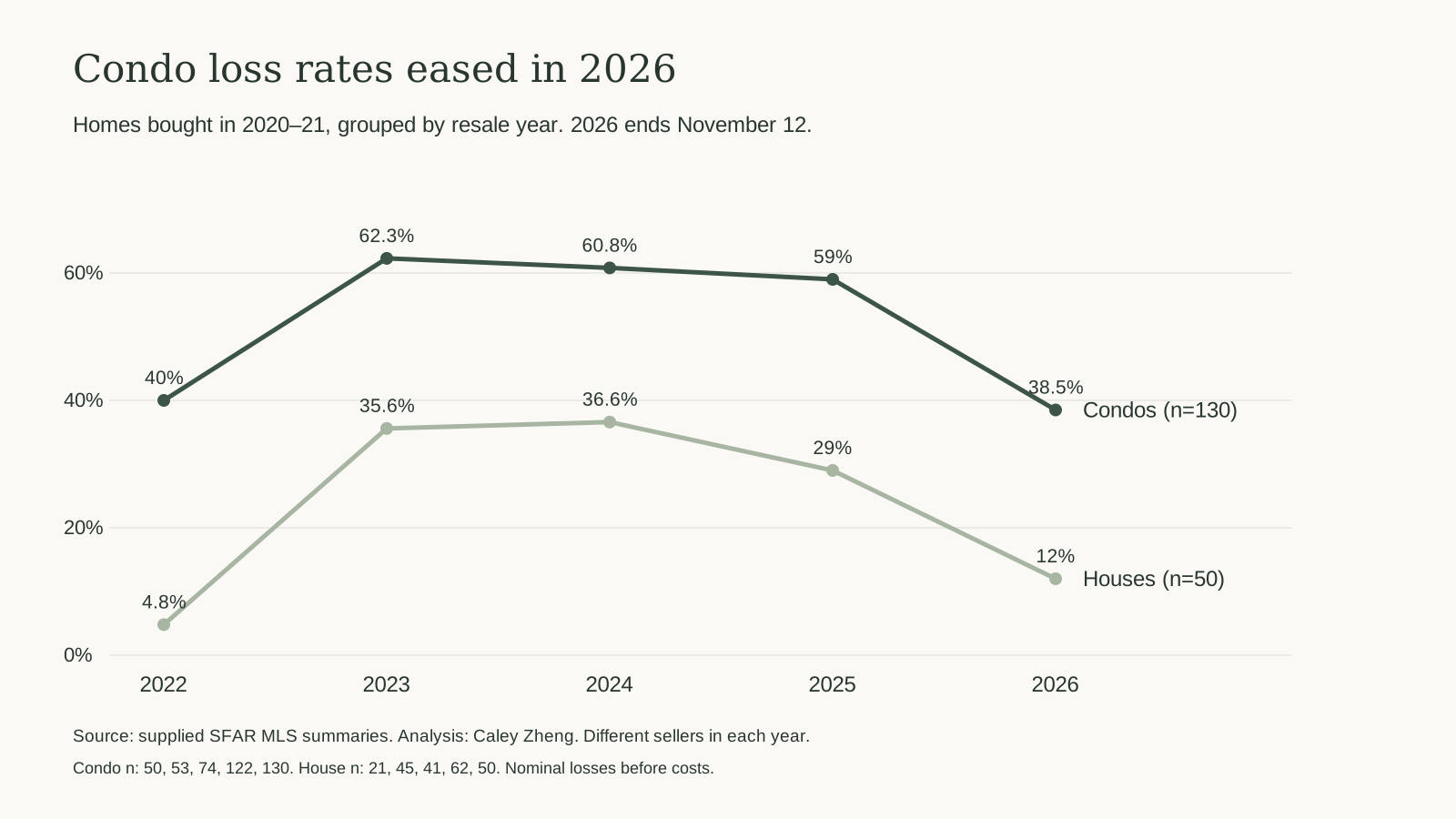
That is a substantial improvement among observed sellers. It does not show that every unsold condo has recovered, or that the same properties gained value each year. These are changing groups of resales, with modest sample sizes.
Size and purchase price made a large difference
| Property type | Sales | Sold below purchase | Median price change |
|---|---|---|---|
| 1-bedroom condo | 53 | 75.5% | −6.9% |
| 2-bedroom condo | 92 | 32.6% | +6.4% |
| 3+ bedroom condo | 43 | 4.7% | +21.4% |
| All condos | 190 | 37.9% | +6.1% |
| Single-family home | 78 | 9.0% | +21.8% |
The supplied bedroom groups account for 188 of the 190 condos. The remaining two are not classified in those groups.
The original purchase price tells a similar story. Nearly 70% of condos purchased for less than $1 million resold below purchase price, versus 11.1% of those purchased for $2 million or more.
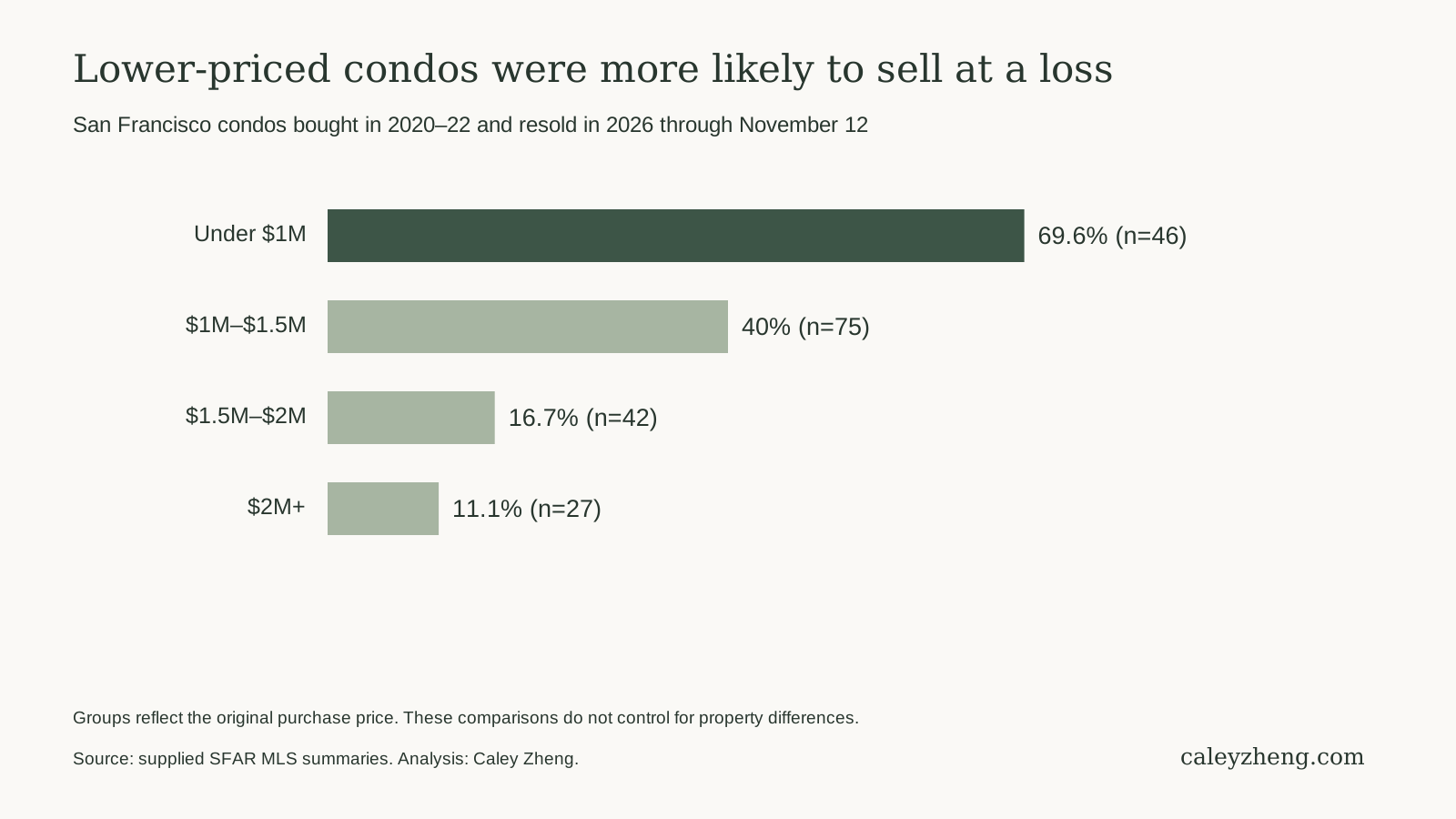
Bedroom count, purchase price, building age and location overlap. These comparisons describe the sellers in the sample; they do not establish which property feature caused a loss.
It extends beyond downtown high-rises
Condos grouped as SoMa, the Financial District and Downtown sold below purchase price 60% of the time, across 42 resales, compared with 32% across 148 resales elsewhere. Those neighborhood labels are broad; the supplied SoMa grouping includes Mission Bay and South Beach.
One-bedroom condos outside those areas still had a 72% loss rate, across 32 resales. Location matters, but the weakness in smaller condos reaches beyond a single neighborhood.
How I would use these numbers
I would evaluate a one-bedroom purchase on whether its housing value and monthly cost make sense with no assumed appreciation. A home can be the right place to live without producing a strong resale gain. A purchase that only works financially if prices rise deserves a closer look.
For buyers, recent comparable sales should guide the offer. The seller’s prior purchase price provides context, but it does not determine today’s market value. Include HOA dues, taxes, insurance, maintenance and likely assessments when comparing ownership with renting. Review the building’s finances and reserves alongside the unit.
For sellers, calculate both estimated net sale proceeds and the cost of holding. Net proceeds after selling costs are different from cash after mortgage payoff. If renting is an option, compare realistic rent with vacancy, repairs, management, dues, taxes, insurance and debt payments. Holding gives you time, but it also exposes you to further costs and price changes.
Read more about San Francisco condo HOA dues and TIC and condo pricing.
Questions buyers and owners ask
Are San Francisco condos a good investment?
This sample does not support a single answer for every condo. Larger condos had stronger resale outcomes than one-bedrooms. The result for a particular purchase depends on price, financing, building costs, holding period and the value of living there.
Why did condos perform differently from houses?
The supplied resale comparisons cannot isolate the causes. Differences in property size, location, buyer demand and ownership costs may all contribute. A higher observed loss rate does not prove that any one factor caused it.
Should I sell at a loss or rent the condo out?
Compare the cost and risk of both options over a realistic holding period. Renting may help cover expenses, but it does not guarantee a price recovery. Your cash needs and willingness to manage a rental matter as much as the resale forecast.
Methodology and limits
This article uses user-supplied summaries attributed to SFAR MLS, covering San Francisco closed sales from January 2020 through November 12, 2026. The underlying transaction records were not supplied for independent replication.
A repeat sale matches the same MLS home key across two closings at least 365 days apart, both since 2020. The supplied cleaning rules exclude future-dated closings, prices below $100,000, property-type changes, living-area changes greater than 10%, and price changes outside ±60%. These filters may also remove genuine substantial gains or losses.
The headline sample includes 190 condos and 78 houses purchased in 2020–22 and resold in 2026. Before cleaning, the supplied condo loss rate was 34% across 240 pairs, versus 37.9% after cleaning. The uncleaned house loss rate was 6% across 142 pairs, versus 9% across 78 after cleaning. The house comparison is particularly sensitive to exclusions.
The trend chart restricts purchases to 2020–21. Condo sample sizes for resale years 2022–26 are 50, 53, 74, 122 and 130; house sample sizes are 21, 45, 41, 62 and 50. Percentages describe observed resales, not all owners. Losses are nominal and measured before costs unless explicitly stated.
Own a condo you bought in 2020–22? Talk with Caley about your numbers.
Working through a TIC decision? The TIC learning center connects the ownership, financing, costs, and buyer-diligence guides.